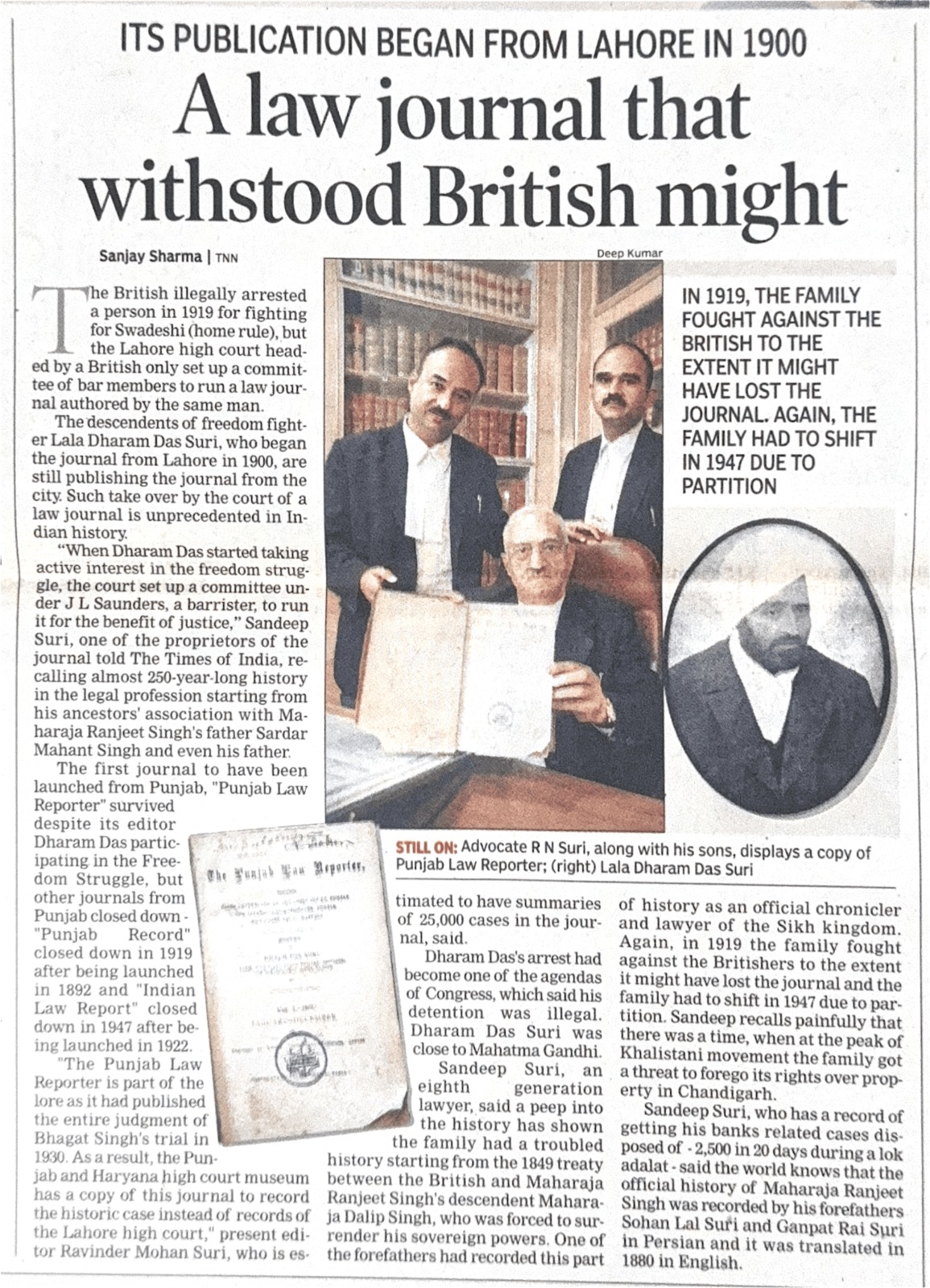
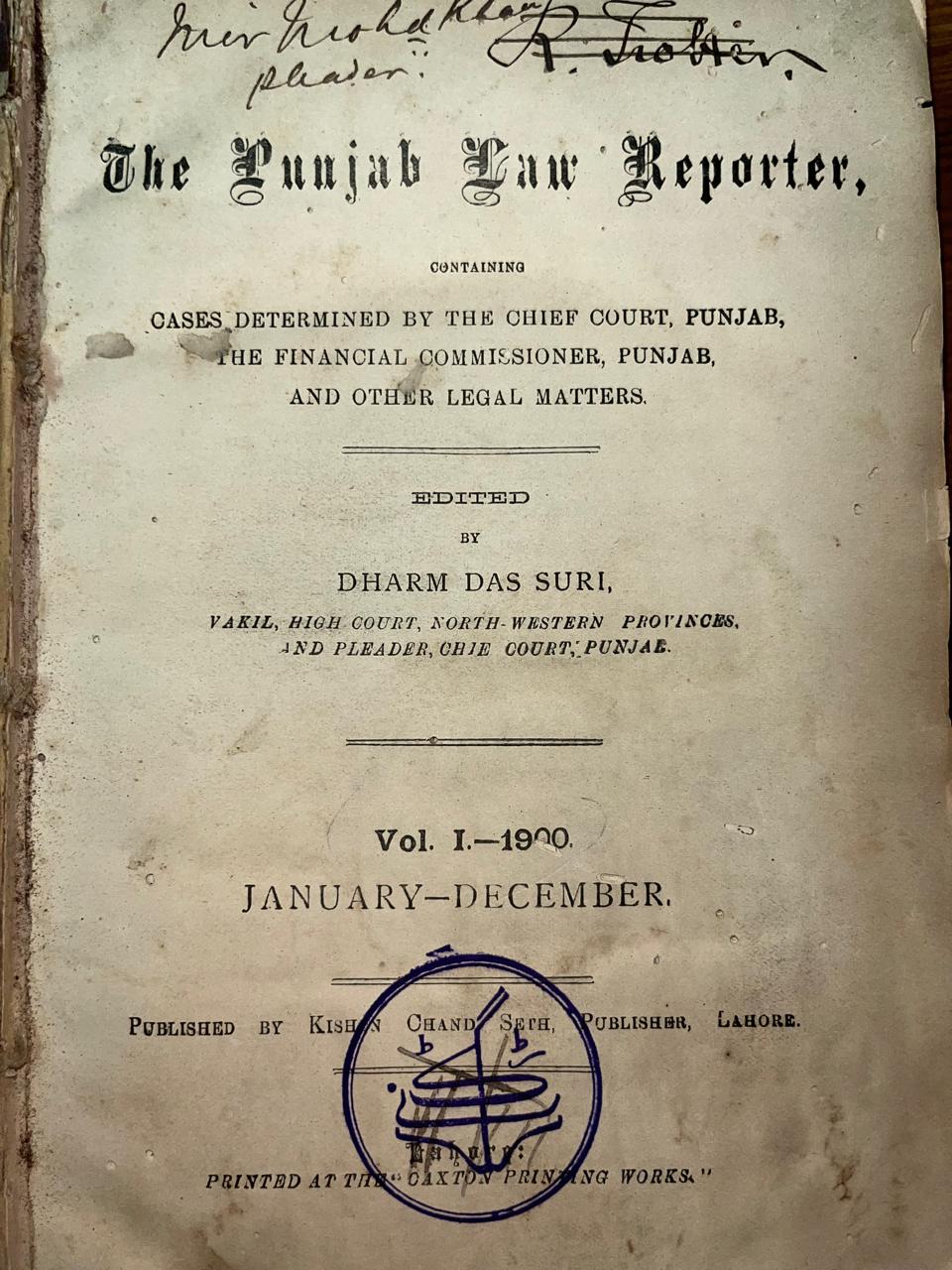
Established in 1900 in Lahore by Lala Dharam Das Suri, the Punjab Law Reporter (PLR) is one of the oldest continuously published legal journals in the Indian subcontinent. Founded during the British colonial era, the journal was created to systematically report and preserve important judicial decisions from the Punjab Chief Court and the Financial Commissioner, making legal precedents more accessible to the Bar and the Bench.
More than a law report, the Punjab Law Reporter has been a witness to India’s legal and political evolution. During the freedom movement, its founder actively participated in the struggle against British rule and was imprisoned in 1919. Despite facing colonial pressure, the publication continued its mission of documenting the development of law. Following the Partition of India in 1947, the journal relocated from Lahore to India, ensuring the continuity of a legal legacy that had already become an integral part of the profession.
For over a century, the Punjab Law Reporter has chronicled thousands of landmark judgments across civil, criminal, constitutional, and commercial law. It is particularly renowned for its comprehensive reporting of decisions from the Punjab and Haryana High Court and has served as an indispensable reference for judges, advocates, legal scholars, and students. Its archives also preserve significant historical cases, including proceedings relating to Shaheed Bhagat Singh’s trial, reflecting its importance not only as a legal publication but also as a historical record of the administration of justice.
Published continuously for over 125 years, the Punjab Law Reporter stands as a symbol of resilience, legal scholarship, and editorial independence. Having survived colonial rule, the upheaval of Partition, and changing judicial landscapes, it remains one of India’s most respected legal reporting journals, preserving the rich jurisprudential heritage of the region for future generations.
the Suri family’s association with legal documentation dates back to the early 19th century, when their ancestors served as court chroniclers and legal advisors during the reign of Maharaja Ranjit Singh.
at a time when official law reports were expensive and inaccessible, PLR was established to provide advocates with timely, affordable, and reliable reporting of judgments and statutory developments.
PLR systematically reported decisions of the Punjab Chief Court and later the Lahore High Court, making judicial precedents readily available to the legal fraternity.
its founder, Lala Dharam Das Suri, believed that the legal profession existed to serve society. His commitment to justice inspired the creation of a publication dedicated to strengthening the rule of law.
following the Partition of India in 1947, the Suri family relocated from Lahore to Shimla and later Chandigarh. Despite leaving behind their printing press, offices and library, they resumed publication in independent India without interruption.
Punjab Law Reporter has successfully endured British rule, two World Wars, India’s Independence, Partition, judicial reorganisation and the transition into the digital age.
as the Punjab High Court moved from Lahore to Shimla and eventually Chandigarh, PLR evolved alongside the institution, continuing its tradition of authoritative legal reporting.
the success of PLR led to the establishment of several landmark legal publications, including The Lahore Law Times (1922), Allahabad Law Times (1923), Current Indian Statutes (1929) and later Delhi Law Times (1965).
the Suri family’s publications earned significant recognition over the decades, with The Lahore Law Times attaining the status of an Official Reporter for statutory and revenue rulings in pre-independence Punjab.
for eight generations, the Suri family has carried forward the vision of its founder, maintaining the highest standards of legal reporting, editorial accuracy and scholarly integrity.
while embracing technological advancements and digital legal research, PLR continues to uphold the authenticity, precision and reliability that have defined it since 1900.
today, Punjab Law Reporter remains one of India’s longest-running and most respected legal journals, continuing its mission of documenting the evolution of law for generations to come.
